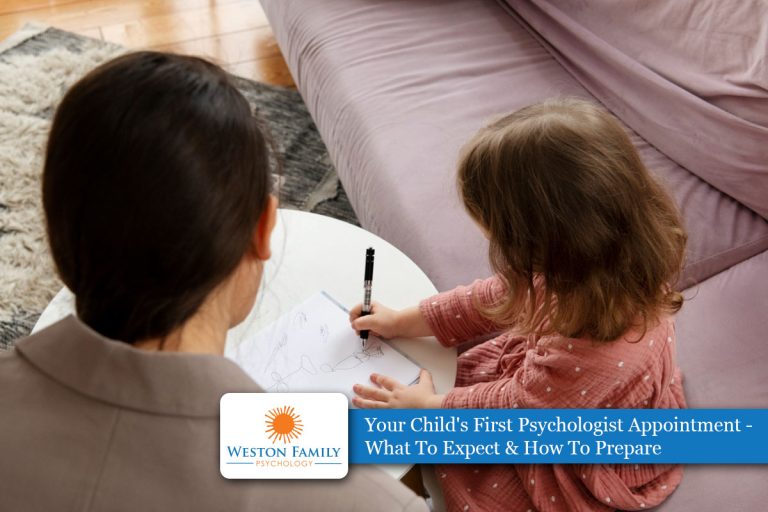
Feeling nervous when booking your child’s first psychology appointment is completely normal, and it can be overwhelming for parents or guardians alike. The reality is, the first session is usually to understand the child’s needs, build rapport and to decide on the best path forward. To put your mind at ease, booking an appointment with a child psychologist near you is a wise move for any parent or guardian.
It takes courage for everyone involved to seek the necessary support with something, and you’re doing the best thing you could to ensure your child gets everything they need to thrive in life.
Why Your Child’s First Appointment With a Child Psychologist Is So Important
Progress in the therapist’s room takes time and effort, and it’s important that you don’t expect everything to be ‘fixed’ in that first session. Your child psychologist will ask lots of questions, engage with your child and learn more about the complexity and nuances of what’s been challenging them. It’s in this first session where strengths and weaknesses come up, learning more about the child’s internal world, and building trust between the psychologist, the child and the parent.
Developing the appropriate treatment plan comes with a number of important details and answers from the parent or guardian to provide the right context for the therapist to build from. The first session builds rapport across the board, and gives the child a safe place to land to express and explore what’s been challenging them. Without these nuances and details, it’s not possible to build the appropriate treatment plan before starting the process.

How To Prepare Your Child For Their First Psychology Appointment
Going to therapy, or trying anything new for a child can be daunting, but with the right parental or guardian preparation children are more likely to open up, feel safe and embrace the new experience. How you talk to your child about therapy is as important as what you say.
Normalize Therapy
Talking about feelings is a necessary part of parenting anyway. Big feelings come up for us all, and learning how to communicate them effectively is a special skill and requires ongoing development. One of the ways you can prepare your child for their appointment is to start opening up the conversation about different feelings, and what they mean.
When sharing that your child will be going to a therapy appointment, it’s helpful to focus on the fact that a therapist is there to help, and not to focus on the child having an issue. You want to make sure they don’t feel like there’s something wrong with them.
Choose The Right Time To Talk
For some children, you could start preparing them a week or two ahead of the scheduled time. For other, more anxious kids, preparing them within two days before the appointment is better, to avoid prolonging it and stimulating more anxiety.
Some important times to maybe avoid would be during a transition like bedtime, or on their way to school. Other times worth avoiding may be if they are already processing something else, or they had a hard day. Try to catch them in a content neutral headspace, and they will likely be more open to the conversation.
Be Honest About Seeing A Child Psychologist
The last thing you need to do is try to beat around the bush, and tell them a great big story that isn’t actually the truth. Using narrative can be a wonderful tool with kids, so just be considerate about how you go about telling them what’s going on. Honesty said with care, and love truly is the best policy.
You could explain that the therapist is a friend who is excited to help them grow in new ways, or a support person who helps us to explore and talk about feelings. Over-promising is also not the best idea, rather than speaking about the therapist as a friend, be more clear about their supportive role in helping out.
What To Expect During Your Child’s First Therapy Session
We want to ensure the children and teenagers who come to see us for therapy feel welcome and safe. We engage your child and ensure we nurture an environment that feels comfortable for them. We use age-appropriate techniques to encourage them to open up, enjoy the experience and leave feeling content.
The three main aspects of the session usually include a personalized assessment using play, observation, interview, and at times standard tests to assess how the child responds. We gear our support towards emotional regulation, problem solving and coping skills that make sense for your child’s unique needs.
We value parental input and offer help to parents to engage their children between each therapy session. In the first session, we welcome parents to join and ensure the child knows their parent is welcome until they are happy to be alone with their child psychologist.
Looking For A Child Psychologist? Visit Weston Family Psychology
At Weston Family Psychology we have a team of licensed child psychologists, who help children with mental, emotional and behavioral challenges such as ADHD therapy, treatment for anxiety, mood disorders, educational intervention, OCD and related challenges, parenting support and family therapy, psychoeducational testing, eating disorders, executive function support and high functioning autism therapy.
Contact us at (954) 388-8336 to learn more about our practice, and to make your child’s appointment.